
The 2026 Medicare supplement rate increase data through October is in, and it confirms that carriers have pursued large rate increases in an attempt to help mitigate high loss ratios. For most large carriers, 2026 average rate increases continued to trend up from 2024 and 2025. With 10 months of approved filing data, the increase amounts are expected to be very close to the final year-end levels.
The charts below summarize the average historical rate increases of the most prominent carriers in the Medicare supplement space. This data pertains only to open blocks of business and does not consider instances where companies are implementing large rate decreases as they re-enter the market using old paper. All carriers besides the largest six have been grouped together as “Other”.
Let’s start with Plan G.
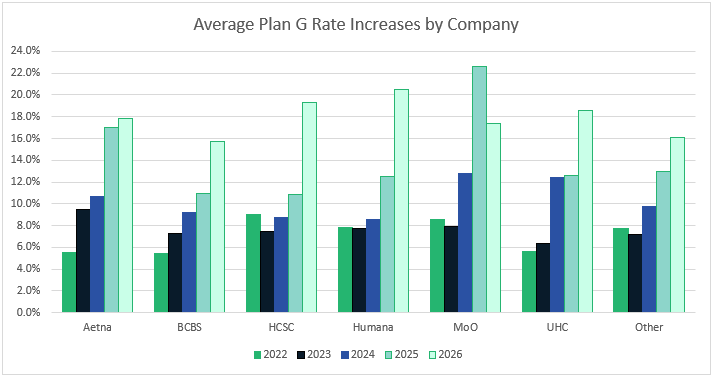
All groups besides Mutual of Omaha show a larger rate increase in 2026 than in previous years. The data shows that Aetna and Mutual of Omaha were ahead of the market with a large jump in increase amounts from 2024 to 2025. Other carriers took smaller increases in 2025, around 11-13%. Those carriers have taken a 5-9% jump in rate increases in 2026. The 2026 industry average increase for Plan G remains at 16.8%, the same level as in Q3.
Next up is Plan N.
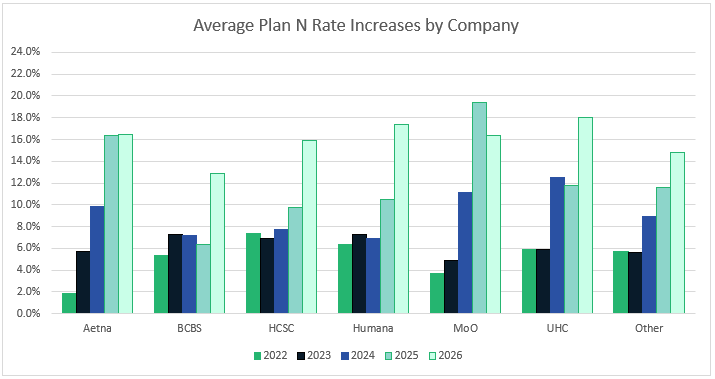
Again, all groups besides Mutual of Omaha display larger increases in 2026 than 2025. You can see that some companies have shown a more gradual reaction to increasing claim trends, while others have acted more swiftly. The 2026 industry average for Plan N is 15.3%.
For all plans, we expect the trend of higher rate actions to continue throughout the rest of 2026 as carriers continue to pursue improved loss ratios. We are looking forward to more 2027 data coming in to see if increases will remain high or cool down.
Our team has extensive experience filing rate increases. We can help guide you through the development of your rating plan and help you get the most difficult filings approved.